
Wildlife · November 6, 2026 · 3 min read
The Great Migration in the Maasai Mara: a guide to the river crossings
By Puan Mara Camp
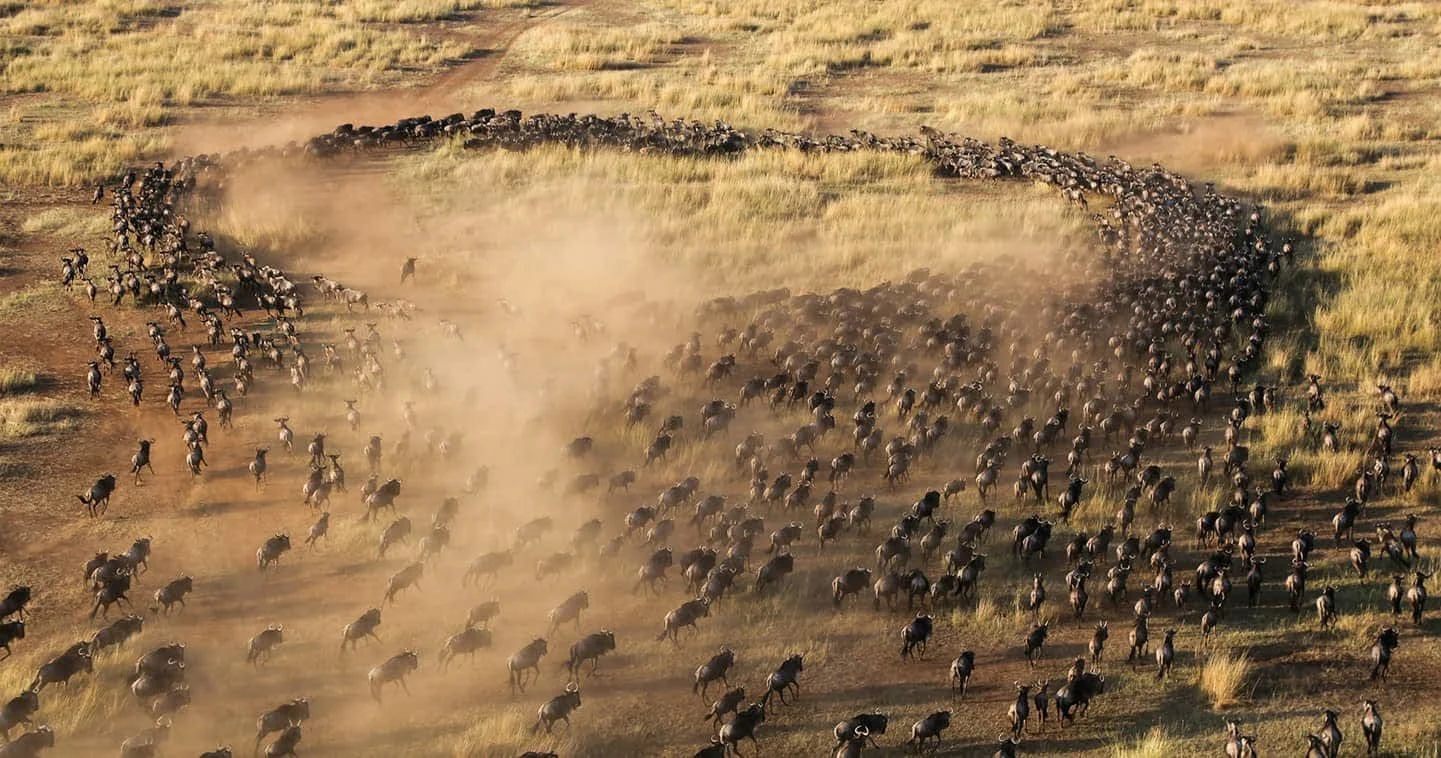
Few sights on earth compare with a Mara River crossing: thousands of wildebeest gathering on the bank, a moment of stillness, then a single animal jumps and the whole column follows.
Every year more than a million wildebeest, together with hundreds of thousands of zebra and gazelle, travel a great circle between Tanzania’s Serengeti and Kenya’s Maasai Mara. They follow the rain and the fresh grass it brings. There is no start or finish line; the herds are always somewhere on the loop. But the part most travellers dream of happens here in the Mara.
When are the herds in the Maasai Mara?
The first herds usually cross into Kenya in July. By August and September the plains of the Mara can be covered with wildebeest as far as you can see, and this is when river crossings are often at their most frequent. In October the herds begin to turn south again, and by November most are heading back towards the Serengeti with the short rains.
These are averages, not a timetable. A late or early rainy season can shift everything by a few weeks. That is why we keep an eye on the herds all year and share what we are seeing with booked guests. You can turn our month-by-month dial to see what each month usually brings.
What actually happens at a crossing
The Mara River winds through the reserve, and the herds have to cross it, sometimes several times, to reach the best grazing. They gather in their thousands at traditional crossing points, where the banks are low enough to scramble down.
Then they wait. Herds can stand on the bank for hours, edging forward and pulling back, because the river is dangerous: Nile crocodiles lie in the shallows and lions often wait in the bushes on the far side. Eventually one animal commits, and the rest pour down the bank after it. A big crossing can last from a few minutes to more than an hour.
How to give yourself the best chance
- Stay at least three nights. Crossings are unpredictable. More time means more chances, and you will see plenty of other wildlife while you wait.
- Take a full-day game drive. With a packed lunch you can stay with the herds rather than driving back to camp in the middle of the day.
- Be patient and quiet. Herds turn back if vehicles crowd the crossing point. Our guides keep a respectful distance, which often means a better view when the herd finally goes.
- Book early. August and September are the busiest months in the Mara. Nine to twelve months ahead is wise for these dates.
Is it worth visiting outside migration season?
Absolutely. The Mara is home to one of Africa’s densest populations of lion, and leopard, cheetah, elephant, buffalo and giraffe live here all year. Outside July to October there are fewer vehicles, the plains are green and the light is beautiful. Many of our guests who come in the green season tell us the Mara felt like theirs alone.
If the migration is the dream, tell us your dates and we will tell you honestly what to expect. Send us an enquiry or sketch your safari in a minute.
Planning your dates?
Check availability